EN RO


#Exhibit of the Month

>>>

The grapevine plant, now widespread across the globe, traces its origins back to the Upper Cretaceous geological period, when species of Vitis Linn appeared on Earth (Mesozoic era), followed later by Vitis vinifera L., the latter already classified among cultivated agricultural plants. Most researchers link the origin of the cultivated grapevine (Vitis vinifera L.) to the wild forest species Vitis sylvestris Gmel. Thickets of Vitis sylvestris Gmel. can still sporadically be found in the groves along the Prut and Dniester floodplains.

During the Precucuteni III - Trypillia A period (ca. 4750-4600 BC), the presence of cultivated grape seeds was clearly documented on pottery from the settlement of Ruseştii Noi I, layer I, kiln A, consisting of a seed impression on a ceramic fragment, with the elongated beak characteristic of the domesticated species Vitis vinifera L. Another seed impression of Vitis vinifera L. was recorded at the settlement of Vărvăreuca VIII, identified on the wall of a painted vessel from the Cucuteni B - Trypillia CI stage (3800-3500/3300 BC). 
In October, on the occasion of the National Wine Day, the National Museum of History of Moldova presents to your attention a unique relic in Southeastern Europe. The exhibit originates from the settlement Brînzeni VIII "Sâiece," belonging to the Cucuteni-Trypillia culture and dated to the Cucuteni AB2 - Trypillia B2 phase (ca. 4050-3800 BC), located in Brînzeni village, Edineț district. The site lies 2 km southwest of the locality, in a triangle formed by the confluence of the Racovăț and Drobiște streams and the local road L36 Bădragii Vechi-Brînzeni. Positioned on land 25-30 meters above the valley, it was discovered in 1966 by archaeologist Nicolaie Chetraru and investigated through excavations between 1978-1980 by Vsevolod Marchevici. 
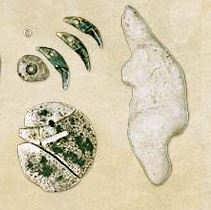
The October exhibit is a grapevine leaf impression discovered in 1980. It comes from pit no. 5, partially investigated, with a maximum depth of 155 cm. From the same archaeological complex near dwelling no. 1, several grape seeds were also recovered, as noted in the excavation report. The grapevine leaf impression appears on a coarse clay lump, fired and vitrified due to secondary burning, reddish in color, with an irregular rectangular, flattened shape. The outer surface is uneven and rough. The impression surface is smoothed, with the leaf veins clearly highlighted. Measuring 99 mm in length, 110 mm in width, and 28-31 mm in thickness, the exhibit presents in full splendor an authentic grapevine leaf impression. Some researchers attribute it to the domesticated grapevine Vitis vinifera L., while others, more skeptical, consider it a wild species. Nevertheless, being discovered in a well-documented archaeological context, together with grape seeds near a dwelling, it provides evidence that grapevine was part of Cucuteni community life 6,000 years ago. These findings allow us to affirm that the process of domestication and the creation of table grapes was already underway. The diversity of Cucuteni ceramic forms, as well as the painting on some vessels, undoubtedly suggests their use as containers for various liquids. Accordingly, the emergence of wine among Cucuteni communities can be taken into consideration.

Virtual Tour


Events Archive


Cultural-Cognitive Activity “The History of Post: From the Carrier Pigeon to the Digital Message”

9 October 2026

Every year, on October 9, the world celebrates World Post Day - an occasion to acknowledge the essential role of the postal sector in people's lives and in business, as well as its contribution to the social and economic development of nations. Established in 1969 by the Universal Postal Union (UPU), this day commemorates the founding of the organization on October 9, 1874, in Berne, Switzerland. Today, UPU brings together 192 member states, including the Republic of Moldova, which joined in 1992.

On this occasion, the National Museum of History of Moldova organized for a group of students from the Republican Sports High School in Chișinău the cultural-cognitive activity "The History of Post: From the Carrier Pigeon to the Digital Message".

Details>>

Round Table “Longing for a Better Past”

8 October 2026

As part of the exhibition "Longing for a Better Past", a round table was held in the Blue Hall of the National Museum of History of Moldova, dedicated to deepening the curatorial themes. The event brought together historians, researchers, and artists in an interdisciplinary dialogue about the memory of communism, the paradox of nostalgia, and the role of art in reinterpreting the past.

The discussions began with Svetlana Boym's distinction between restorative and reflective nostalgia. Participants analyzed how the socialist past is remembered and re-signified, emphasizing that political nostalgia is not a longing for the system itself, but for the coherence and stability it promised, yet never fulfilled

Details>>

Exhibition Opening “Longing for a Better Past”

8 October 2026

On October 8, 2026, in Hall 4 of the National Museum of History of Moldova, the international exhibition "Tânjind după un trecut mai bun / Longing for a Better Past" was inaugurated. The event was opened by Mr. Alexandru Argint, General Director of MNIM, followed by interventions from curators Andreea Căpitănescu and Olivia Nițiș, as well as artist Ghenadie Popescu, who presented the concept and central messages of the project.


Details>>

Opening of the exhibition “From Grapes to Wine, From Earth to Food”

6 October 2026

The vineyard, the harvest, and the family gathered around the table are the themes of the exhibition "From Grapes to Wine, From Earth to Food", opened at the National Museum of History of Moldova (NMHM). Organized under the patronage of the Food and Agriculture Organization of the United Nations (FAO), the exhibition was launched in the context of National Wine Day and marks World Food Day, celebrated on 16 October.


Details>>

Launch of the Romanian Edition of the Volume “Dividing Europe. Consequences of the Molotov–Ribbentrop Pact. Perspectives from Central and Eastern Europe”

25 September 2026

At the National Museum of History of Moldova, the Konrad Adenauer Foundation - Moldova Office, in partnership with the National Association of Young Historians of Moldova and MNIM, launched the Romanian edition of the volume "Dividing Europe. Consequences of the Molotov-Ribbentrop Pact. Perspectives from Central and Eastern Europe".

The event brought together researchers, historians, students, and representatives of partner institutions, offering participants the opportunity to engage in dialogue with the authors of the original German edition.

Details>>

Opening of the Exhibition “Vestiges of the Cucuteni–Trypillia Culture from the Republic of Moldova”

24 September 2026

On September 24, 2026, in Hall 2 of the National Museum of History of Moldova, the opening of the temporary exhibition "Vestiges of the Cucuteni-Trypillia Culture from the Republic of Moldova" took place, dedicated to one of Europe's most fascinating prehistoric civilizations.

The event was opened by Alexandru Argint, Deputy Director of NMHM, and Sergiu Bodean, museum curator. During the opening, visitors had the opportunity to discover outstanding Cucuteni artifacts - painted ceramics, anthropomorphic and zoomorphic figurines, flint, stone, bone and antler tools, copper pieces, as well as dwelling fragments with constructive and decorative elements.

Details>>

Scientific Lecture – “Genomics of Ancient Humans and Pathogens: Paleogenetic Research on European Hunter-Gatherers and Plague Pandemics”

23 September 2026

On September 23, 2026, the National History Museum of Moldova had the honor of hosting in the Blue Hall a lecture delivered by Prof. Dr. Cosimo Posth, a renowned researcher in paleogenetics, professor at the University of Tübingen and the Senckenberg Centre for Human Evolution and Paleoenvironment (Germany). The topic of the presentation was "Genomics of Ancient Humans and Pathogens: Paleogenetic Research on European Hunter-Gatherers and Plague Pandemics."

Details>>

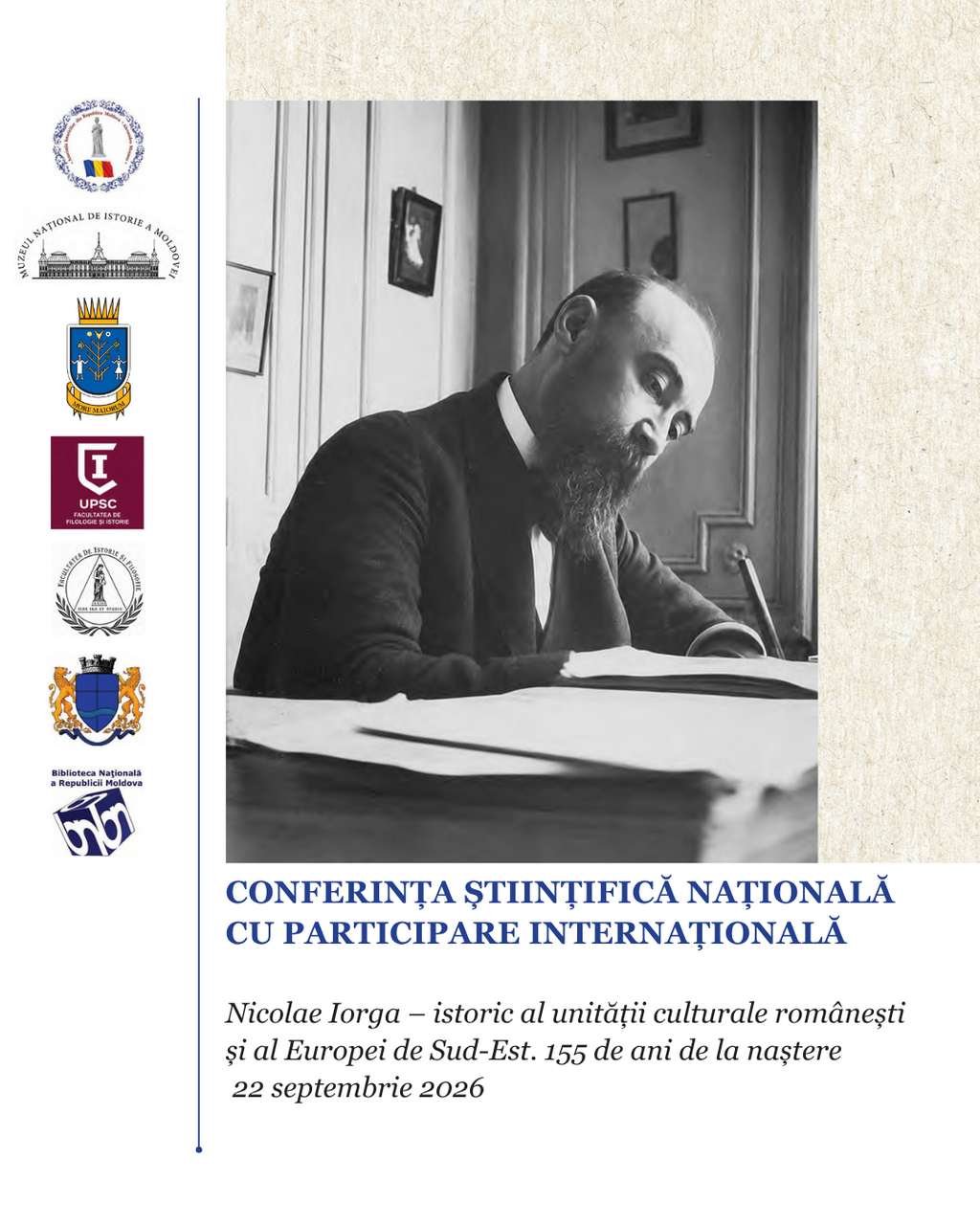
National Scientific Conference with International Participation “Nicolae Iorga – Historian of Romanian Cultural Unity and of South Eastern Europe. 155 Years Since His Birth”

22 September 2026

On Tuesday, September 22, 2026, the National Museum of History of Moldova hosted the National Scientific Conference with international participation "Nicolae Iorga - Historian of Romanian Cultural Unity and of South Eastern Europe. 155 Years Since His Birth." The event was organized by the Association of Historians of the Republic of Moldova "Alexandru Moșanu," in partnership with the National Museum of History of Moldova, the National Museum of Ethnography and Natural History, Moldova State University, "Ion Creangă" State Pedagogical University of Chișinău, the Brăila Museum "Carol I" (Romania), the National Library of the Republic of Moldova, and Lexon Prim Publishing House.

Details>>

International Conference “Cultural Heritage of Yesterday – Implications for the Development of Tomorrow’s Society”, 14th Edition

17 September 2026

On September 18, 2026, the National Museum of History of Moldova hosted the section "Archaeology Today: Problems and Solutions", part of the 14th edition of the international conference "Cultural Heritage of Yesterday - Implications for the Development of Tomorrow's Society", held in Iași-Chișinău-Lviv-Bucharest.

The section brought together researchers from prestigious institutions: the National Museum of History of Moldova, the Institute of Cultural Heritage (Chișinău), the National Museum Complex "Moldova" Iași, Botoșani County Museum, National Museum of Bucovina Suceava, "Alexandru Ioan Cuza" University of Iași, University of Bucharest, Eco-Museum Research Institute Tulcea, Romanian Academy - Iași Branch, Leibniz Centre for Archaeology (Germany), and Freie Universität Berlin (Germany).

Details>>

Preliminary Results of the Project “Communism Made Understandable for Young People. Transmitting the Recent Past to New Generations in Romania and the Republic of Moldova” Presented at the National Congress of Romanian Historians

12 September 2026

Between September 9-12, 2026, the team of the international research project "Communism Made Understandable for Young People. Transmitting the Recent Past to New Generations in Romania and the Republic of Moldova" (code PN-IV-PCB-RO-MD-2024-0039), carried out within the National Museum of History of Moldova with the support of the program "Complex Bilateral Projects with the Republic of Moldova", participated in the proceedings of the National Congress of Romanian Historians "Historiography of the 21st Century: Developments, Challenges, and Opportunities", organized under the aegis of the Romanian Academy and the National Committee of Romanian Historians.

Details>>

Opening of the International Biennial of Decorative Art, 8th Edition

10 September 2026

On September 10, 2026, the National Museum of History of Moldova hosted the opening of the International Biennial of Decorative Art - Chișinău 2026, 8th Edition, one of the major events dedicated to professional contemporary decorative art.

The exhibition brings together eighty works presented by artists from the Republic of Moldova and Romania, offering the public a broad perspective on the diversity of expression in contemporary decorative art.

Details>>

Opening of the Exhibition “Voices of Synagogues. The Echo of Spirit through Time”

7 September 2026

The Jewish Community of the Republic of Moldova, in partnership with the National Museum of History of Moldova, presents the documentary-photographic exhibition “Voices of Synagogues. The Echo of Spirit through Time”, open to the public between September 7–30, 2026, on the ground floor of the museum. The opening took place on September 7, at 14:00, in the presence of representatives of cultural institutions and the Jewish community.


Details>>

“Sybir – The Prison of Nations” opened at the Memorial of the Victims of Communism and of the Resistance in Sighet

2 September 2026

Between 2-30 September 2026, the National Museum of History of Moldova and the Memorial to the Victims of Communism and of the Resistance in Sighet, in cooperation with the Sybir Memorial Museum in Bialystok and the Embassy of the Republic of Poland in the Republic of Moldova, inaugurated the travelling exhibition "Sybir - The Prison of Nations." The Moldovan-Polish exhibition message, developed by the Sybir Memorial Museum in Bialystok and the National Museum of History of Moldova, brings to the public's attention a history from the time of the Second World War, through photo-documentary testimonies about people living under Soviet occupation.

Details>>

International scientific-practical seminar “Memorial Peloton: exchange of best practices in historical knowledge and the educational valorization of the memory of the totalitarian past”

31 August 2026

On 30-31 August 2026, the National Museum of History of Moldova, in partnership with the Embassy of the Republic of Lithuania in Moldova and the Hanns Seidel Foundation - Republic of Moldova, organized the international scientific-practical seminar "Memorial Peloton: exchange of best practices in historical knowledge and the educational valorization of the memory of the totalitarian past." The event was dedicated to commemorating the victims of totalitarian regimes and the dramatic consequences experienced in Central and Eastern Europe following the signing of the secret additional protocol to the Ribbentrop-Molotov Pact on 23 August 1939 by Nazi Germany and the USSR.

Details>>

“The Republic of Moldova at 35 Years of Independence: ‘The Russian Lesson’ in Public Dialogue”

26 August 2026

On the occasion of the 35th anniversary of the proclamation of the Independence of the Republic of Moldova, the Romanian Cultural Institute "Mihai Eminescu" in Chișinău, in partnership with the National Museum of History of Moldova, organized on August 26 the conference "The Republic of Moldova at 35 Years of Independence: ‘The Russian Lesson' in Public Dialogue."

The event took as its starting point the novel "The Russian Lesson" by writer Maria Pilchin, which provided the framework for an interdisciplinary discussion at the intersection of literature, history, psychology, and philology.

Details>>

Opening of the Photo Documentary Exhibition “Diplomacy Across Generations. 35 Years of Dialogue, Trust, and Cooperation”

25 August 2026

The Ministry of Foreign Affairs inaugurated, at the National Museum of History of Moldova, the photo documentary exhibition "Diplomacy Across Generations. 35 Years of Dialogue, Trust, and Cooperation", organized on the occasion of the 35th anniversary of the proclamation of the independence of the Republic of Moldova.

The event brought together foreign ministers, ambassadors, representatives of the diplomatic corps accredited in Chișinău, and diplomats from different generations.

Details>>

Opening of the Photo Exhibition “Renaissance in Glory and Power” at the Parliament of the Republic of Moldova

24 August 2026

Today, at the Parliament of the Republic of Moldova, the photo exhibition "Renaissance in Glory and Power" was opened, dedicated to Ukraine's sacred heritage affected by the aggression of the Russian Federation against Ukraine. The event marks the 35th anniversary of Ukraine's Independence and brings to public attention churches and sacred structures of various denominations that have been devastated by the full-scale war.


Details>>

23 August – European Day of Remembrance for Victims of Totalitarian Regimes

23 August 2026

The National Museum of History of Moldova once again joined this year's public campaign "Remember. 23 August", initiated by the European Network Remembrance and Solidarity (ENRS), marking the European Day of Remembrance for Victims of Totalitarian Regimes.


Details>>

Opening of the Exhibition “Polish Discoveries that Changed the World” at the Local Museum of History and Ethnography Trușeni

18 August 2026

On August 18, 2026, the Local Museum of History and Ethnography Trușeni hosted the vernissage of the traveling exhibition "Polish Discoveries that Changed the World", organized by the Polish Institute in Bucharest and presented in partnership with the National Museum of History of Moldova.

The event took place in a festive atmosphere, bringing together representatives of cultural institutions and local administration. Among the participants were Olga Andranovici and Livia Ermurachi, Deputy Directors of NMHM, alongside Viorica Beregoi, Mayor of Trușeni commune, and Carolina Cheianu-Tudos, Mayor of Trușeni commune and Director of the Local Museum of History and Ethnography.
Details>>

<< 1 2 3 4 5 6 7 8 9 10 11 12 13 14 15 16 17 18 19 20 21 22 23 24 25 26 27 28 29 30 31 32 >>


Independent Moldova
Moldavian Soviet Socialist Republic
Bessarabia and MASSR between the Two World Wars
Bessarabia and Moldavian Autonomous Soviet Socialist Republic in the Period between the Two World Wars
Revival of National Movement
Time of Reforms and their Consequences
Abolition of Autonomy. Bessarabia – a New Tsarist Colony
Period of Relative Autonomy of Bessarabia within the Russian Empire
Phanariot Regime
Golden Age of the Romanian Culture
Struggle for Maintaining of Independence of Moldova
Formation of Independent Medieval State of Moldova
Era of the
Great Nomad Migrations
Early Middle Ages
Iron Age and Antiquity
Bronze Age
Aeneolithic Age
Neolithic Age
Palaeolithic Age


Come to Museum! Discover the History!
  
Visit museum
Visit museum
Summer schedule: daily
10am – 6pm.

Winter schedule: daily
10am – 5pm.
Closed on Mondays.
Entrance fees:  adults - 50 MDL, Pensioners, students - 20 lei, pupils - 10 MDL. Free access: enlisted men (...)

WiFi Free Wi-Fi Zone in the museum: In the courtyard of the National History Museum of Moldova there is Wi-Fi Internet access for visitors.


#Exhibit of the Month

The grapevine plant, now widespread across the globe, traces its origins back to the Upper Cretaceous geological period, when species of Vitis Linn appeared on Earth (Mesozoic era), followed later by Vitis vinifera L., the latter already classified among cultivated agricultural plants. Most researchers link the origin of the cultivated grapevine (Vitis vinifera L.) to the wild forest species Vitis sylvestris Gmel...

Read More >>


The National Museum of History of Moldova takes place among the most significant museum institutions of the Republic of Moldova, in terms of both its collection and scientific reputation.

©2006-2026 National Museum of History of Moldova
Visit museum 31 August 1989 St., 121 A, MD 2012, Chisinau, Republic of Moldova
Phones:
Secretariat: +373 (22) 24-43-25
Department of Public Relations and Museum Education: +373 (22) 24-04-26
Fax: +373 (22) 24-43-69
E-mail: office@nationalmuseum.md
Technical Support: info@nationalmuseum.md
Web site administration and maintenance: Andrei EMILCIUC


The National Museum of History of Moldova takes place among the most significant museum institutions of the Republic of Moldova, in terms of both its collection and scientific reputation.

©2006-2026 National Museum of History of Moldova
Visit museum 31 August 1989 St., 121 A, MD 2012, Chisinau, Republic of Moldova
Phones:
Secretariat: +373 (22) 24-43-25
Department of Public Relations and Museum Education: +373 (22) 24-04-26
Fax: +373 (22) 24-43-69
E-mail: office@nationalmuseum.md
Technical Support: info@nationalmuseum.md
Web site administration and maintenance: Andrei EMILCIUC

menu
The National Museum of History of Moldova takes place among the most significant museum institutions of the Republic of Moldova, in terms of both its collection and scientific reputation.
©2006-2026 National Museum of History of Moldova
Visit museum 31 August 1989 St., 121 A, MD 2012, Chisinau, Republic of Moldova
Phones:
Secretariat: +373 (22) 24-43-25
Department of Public Relations and Museum Education: +373 (22) 24-04-26
Fax: +373 (22) 24-43-69
E-mail: office@nationalmuseum.md
Technical Support: info@nationalmuseum.md
Web site administration and maintenance: Andrei EMILCIUC