#Exhibit of the Month #Exhibit of the Month
July 2023
An accessory “with a human destiny”
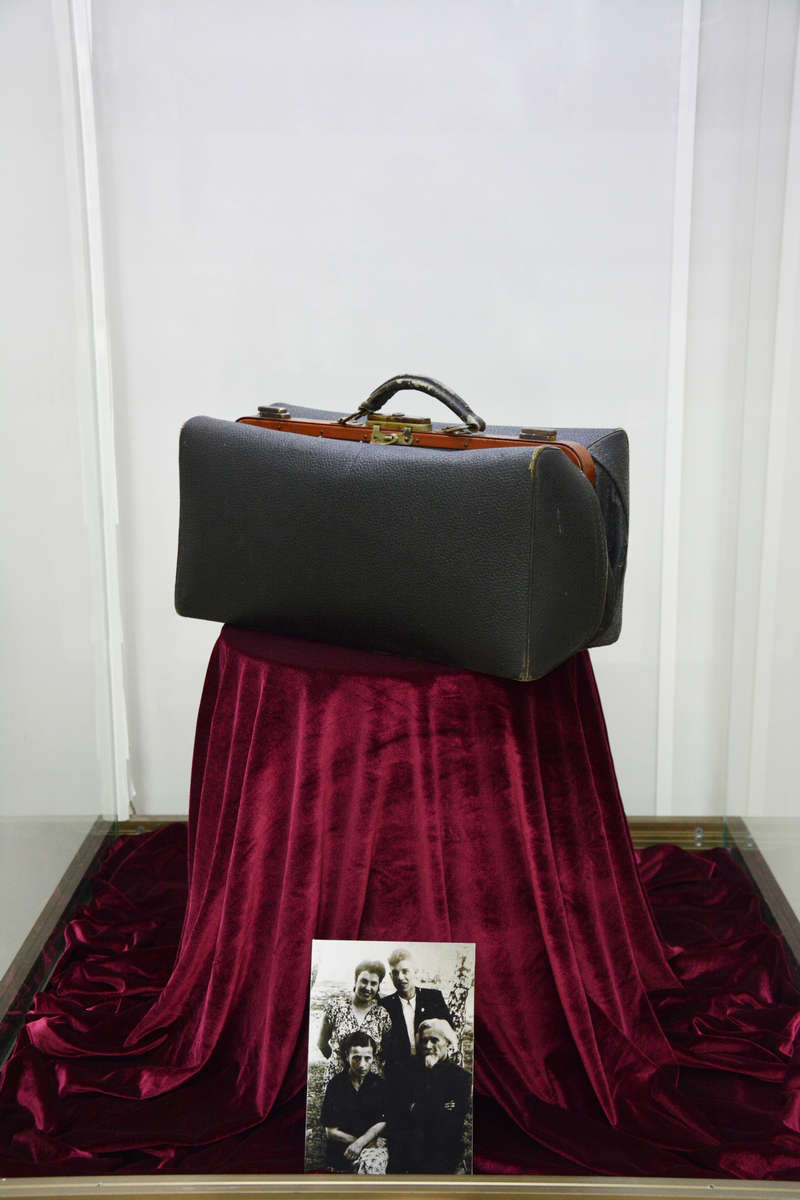 In the context of July 6 - the Day of Commemoration of the Victims of Stalinism in the Republic of Moldova, we bring to the visitor's attention an exhibit that evokes the dramatic fate of one of the thousands of victims of the Stalinist deportations from the Moldavian SSR. The July exhibit is represented by the travel bag that the scientist Alexei Bârladeanu took with him on the night of July 6, 1949, when he was forcibly taken from Chisinau and, together with his wife and son Iulius, were sent to Siberia. The reason for their deportation, incriminated by the repression bodies, would have been "collaboration with the fascists". The travel bag, together with other objects used by the scientist during his deportation (pot, plate, spoon and knife), became part of the museum's heritage in 1994, having been donated by his daughter, Vera Bârlădeanu.
 The travel bag - translated from French, "travel bag" - has its origins in America. In the middle of the 19th century, the construction of railways took off here. The availability of tickets caused great interest in travel. Consequently, there is an increased demand for practical, inexpensive means of transporting luggage. The first travel bags were made from pieces of old carpets, so called - carpet bags. They weren't very durable, but they were comfortable, the empty bag rolled easily and didn't take up much space. Such accessories were closed with a single lock. Later, bags began to be made of leather, with leather and metal handles, with reliable fasteners - which increased their durability and practicality, but at the same time the cost. From among simple items, travel bags have moved into the category of expensive, luxury items. It was in this role that the bag gradually took its place in the fashion world as an indispensable accessory for lawyers, doctors, businessmen, becoming in a way the "face" of a respectable person. Previously, these were travel bags that only men used. The piece displayed in this showcase is made of black faux leather, lined inside with black satin. It has a rectangular shape, rounded edges, a metal plate and a short leather handle. It closes with three metal padlocks, the middle one can be locked with a key. It was manufactured in the Soviet Union, in the 40s of the 20th century. The mediocre state of preservation is evidence of its use in adverse circumstances. The travel bag has a great memorial value. This accessory "with a human destiny" is a testimony of the iniquities that the scientist Alexei Bârlădeanu - pioneer of genetics and selection in Bessarabia - went through. Alexei Bârladeanu was born in Comrat, Tighina county, on March 6, 1883, in the family of Gheorghe Bârladeanu and Elena Iordan. After graduating from the Royal High School in Comrat, in 1899, he became seriously ill with lungs and went to be treated in a sanatorium in Switzerland. In 1912, he graduated from the Faculty of Agronomy and Biology in Leipzig. He knew Romanian, French, German, Russian and Turkish perfectly. In 1920, he married Hilda, then a student at the School of Fine Arts in Zurich. In 1925, at her insistence to meet his parents, they come to Bessarabia, where he is actively involved among Bessarabian intellectuals. In 1932, he moved to Chisinau, continuing his research, working as an agronomist and breeder in the plant breeding laboratory of the Faculty of Agronomy in Chisinau. The ordeal of the Bârlădeanu family begins as soon as Bessarabia is occupied. Hilda, his wife, was the first to fall prey to the Red Terror. She is arrested and escorted to the Kotlas and Verhneaia Tavda camps in the Urals. She was released later, and then in 1949, together with her husband and son, they were picked up and deported to the town of Barit, Gurievsk district, Kemerovo region. Alexei Bârlădeanu continued his research even in the unfavorable conditions of Siberia, but his work was not appreciated. Nor were the multiple requests to be rehabilitated. Returned to Chisinau in 1957, he lives in total poverty. Morally destroyed, old and sick, Alexei Bârlădeanu died on May 11, 1960, without knowing the joy of rehabilitation. It was not until July 17, 1991 that the Prosecutor's Office of the Republic of Moldova issued the rehabilitation document to his descendants. In the picture: Alexei Bârlădeanu, with his wife and son Iulius, together with his daughter Vera (standing) arriving to visit Siberia, 1953.
|

















 31 August 1989 St., 121 A, MD 2012, Chisinau, Republic of Moldova